
HBR Speed is being exceeded
The Harbour Energy 1H26 result


Dear reader
Harbour Energy ticker HBR is one of the world’s largest and most geographically diverse independent oil and gas companies. That’s what their IR would tell you. With operations across Europe, Latin America, North Africa and Southeast Asia. Significant role in meeting the world’s energy needs. Standard stuff.
What the numbers say is more interesting.
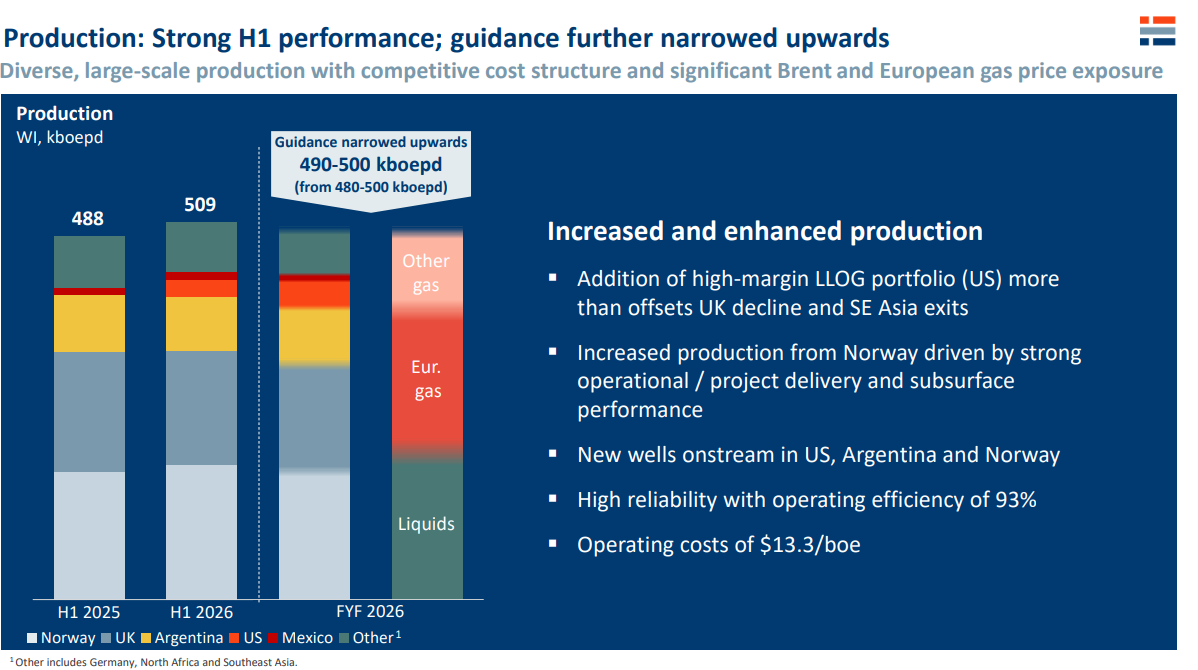
Production in 1H26 came in at 509 kboepd — a beat — and full-year guidance was nudged higher. Mexico and the US contributed a little more, but HBR remained largely a UK and Norway story. The grim grey and gunmetal blue segments on the chart. Grim because of tax.
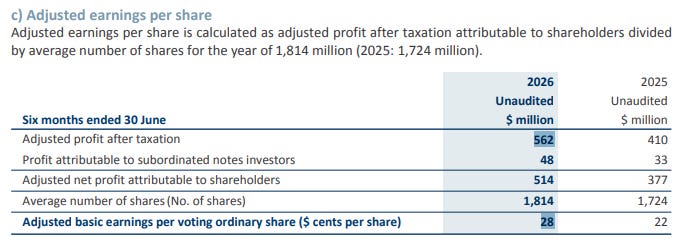
Despite that tax, Harbour still generated $0.28 per share of adjusted earnings in the first half. Call it about 20p a share earned in six months on a share you can buy today for 243p. An adjusted PE of roughly 6x.
Wait, what?
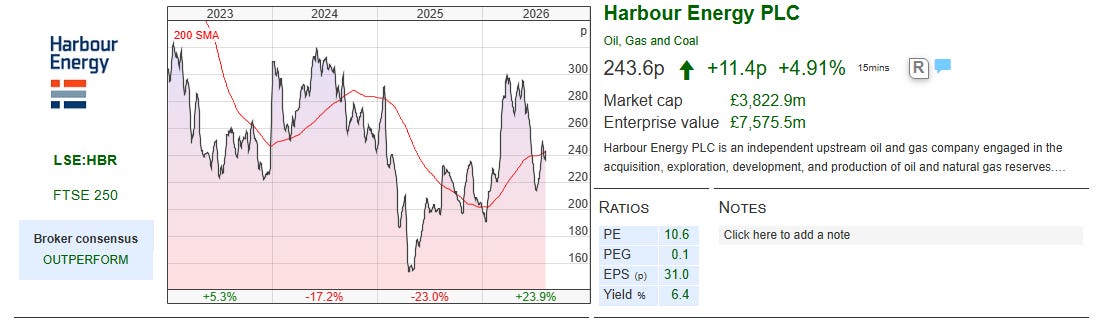
A company that just reported a £2.76bn operating profit in six months, that sells the very commodities being disrupted by conflict in the Gulf, currently costs you £3.8bn to buy the entire equity. Even after the usual Eagle-Eyed correction (yes, operating profit is not bottom-line profit), the actual net profit of $562m / £436m still leaves you at a PE of about 6x.
There are several reasons why that 6x is not the full story:
The LLOG acquisition only completed in February 2026. We have not yet seen a full period of its contribution.
Argentina, the US and Mexico are still early. And they do not charge 78% tax rates.
Deleveraging is happening faster than the headline debt numbers first suggest.
Buybacks at 243p.
The North Sea decommissioning tax carry-back — more on that shortly.
Here’s a segmented 1H26 performance:
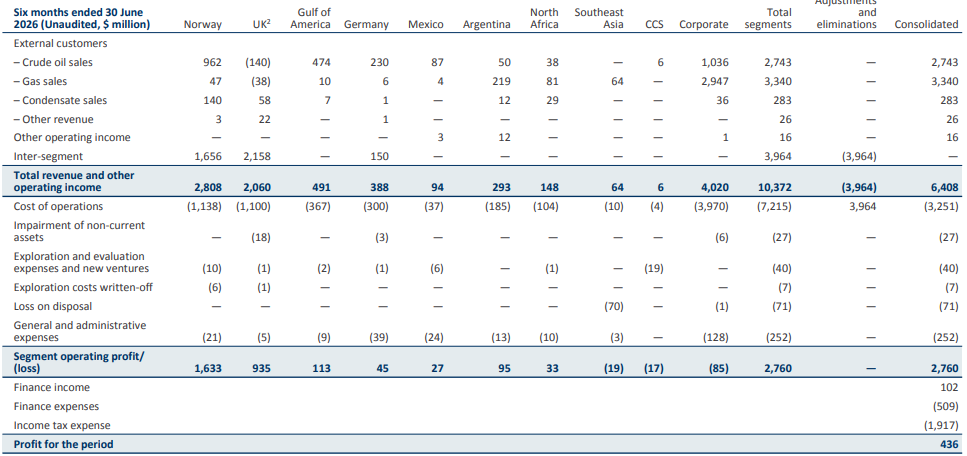
We probably need to talk about the -$0.51bn Finance Expense and -$1.91bn Tax i.e. the -$2.42bn of deductions between the Op Profit and Net Profit don’t we? But before I do, first let me show you the money.
$2.86bn of actual cash flow from operating activities post tax.
In six months reader. In six months. Let that sink in. For a marcap of $5.1bn.
During a period when, yes there was war, but when Trump’s peace proclamations and finance shenanigans almost certainly flooding short contracts at Uncle Sam’s expense crashed the Crude Oil price again and again and again.
Oil needed to appear to be in surplus no matter what. Of course paper contracts of Oil don’t create molecules and that’s why the crack spreads are off the charts.
Let’s reduce that $2.86bn of cash. By -$0.93bn capex and -$0.22bn interest charges so there’s “only” $1.76bn of free cash flow….. and one heck of a lot of non-cash charges that reduce the profit down to that $0.56bn adjusted net profit that was a PE of 6X, right?
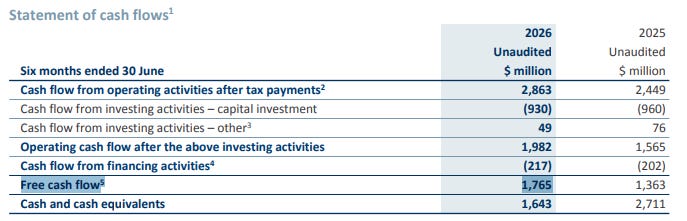
#1 TAX
Tax was a heavy hit: a -$1.92bn net tax charge.
Break that down and Harbour’s total tax figure is actually $2.37bn in current tax payable, offset by -$0.45bn of deferred tax. That deferred tax is an accounting credit that lowers today’s reported tax charge due to timing differences (like investment allowances).
Even with that credit, the total tax charge leaves HBR with an ~81% effective tax rate. That’s even higher than the 78% statutory rates in Norway and the UK (via the Energy Profits Levy).
Why is the effective rate 81% instead of 78%?
When HBR incurs losses or expenses in regions with lower tax rates (or zero tax relief), those losses can’t fully offset profits earned in high-tax regions like the UK and Norway.
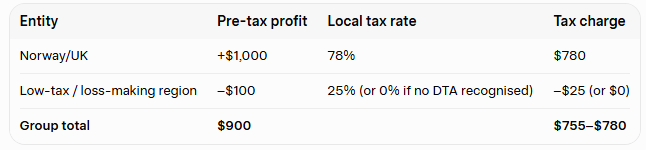
Effective Tax Rate = $780/$900 = 86.7%
Because lower-tax losses “muddy the water,” the overall group effective rate ends up well above the headline 78% rate.
So tax is eye watering but there are some reasons to save your tears. No woman, No cry. (or no man, or no humanoid of other gender label, no cry).
As the proportion of profit from Argentina, SE Asia, USA and other regions grows then the proportion of 78% tax declines. Sorry Healey, sorry UK taxpayer, but HBR isn’t going to be growing its north sea operation by investing much or anything into further production in the UK beyond essential maintenance or perhaps opportunistic acquisitions of distressed UK or Norwegian entities with usable tax losses.
However, the North Sea footprint carries a major structural tax advantage: decommissioning carry-backs.
Under UK and Norwegian tax rules, when HBR eventually decommissions its North Sea fields, it can offset those Asset Retirement Obligations (ARO) against past tax paid at up to the 78% rate. For an estimated gross decommissioning profile of ~$10bn, the net cash exposure to HBR could ultimately be closer to ~$2.2bn, provided sufficient historical tax has been paid across those specific legal entities.
That is hidden value at HBR. Nowhere in the price.
You don’t get to do this carry back in the USA where ARO cannot be used this way (any more). A liability is a liability. You pay up for ARO coz Uncle Sam won’t. But Auntie Brittania will. And Auntie Nora from Norway too. Part paid out of past taxes. The thing is you won’t find this tax asset that HBR is accumulating on the balance sheet.
You won’t see a single “decommissioning tax asset” sitting on the balance sheet today. Under IAS 12 (Income Taxes), future tax relief is accounted for through deferred tax timing differences and net operational cash flows when spent, rather than recognised as a upfront asset. The primary explicit tax receivable line tied to decommissioning on the 1H26 balance sheet is a specific $138m offset asset (up $17m over the past 12 months).

While this future tax shield is realised gradually over decades as fields reach end-of-life—meaning its present value must be discounted for the time value of money—it represents a crucial downside cushion frequently overlooked in crude NAV calculations.
My estimate of the total potential nominal tax refund over the life of these fields is about $7bn. This is based on applying the ~78% tax relief to the current $7.42bn decommissioning liability, plus the additional accretion (the ~$0.3bn annual unwinding of discount shown in HBR’s finance expense) as those future obligations mature.

Because up to 78% of these cash outflows are sheltered by tax carry-backs, the net economic cash burden facing Harbour is only a fraction of the gross figure on the balance sheet.

That means HBR’s true underlying Net Asset Value is significantly higher than the $6.64bn official accounting equity figure suggests.
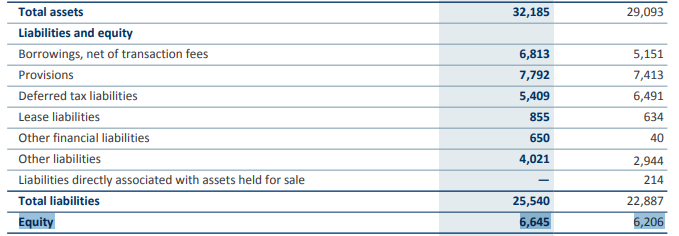
With the market cap currently sitting at just £3.8bn ($5.1bn), HBR trades at an official ~23% discount to the $6.64bn NAV—and an economic discount of up to 50% once you adjust for the real net impact of the decommissioning tax shelter.
WAIT, WHAT???????
#2 Debt
Gross debt was $4.4bn or 0.6X EBITDAX at the end of FY25.
Then HBR bought LLOG in February 2026 for $3.2bn of debt. By rights that points towards $7.61bn total debt. But gross debt was $6.81bn at 30/06/26.

It gets better. Cash balances at 30/06/26 totalled $1.64bn.
So net debt was just $5.17bn.
So just $0.87bn more debt despite the $3.2bn purchase in early 2026.
Net interest costs were $0.122bn which is about a ~4.3% interest charge. This is because HBR inherited bonds from Wintershall Dea that have attractive rates with some as low as 1.332% per annum. WOW!
Very attractive rates indeed.

Eagle-eyed readers will say Finance Expenses were $0.509bn so 80% of these expenses were not actually interest on debt.
$79m is unrealised losses which are losses that relate to a future year but IFRS9 forces you to every year treat them as a current year loss - similar to what I’ve written about at DEC. That’s $79m of hidden profit, really.
$42m of fees are one-off exceptional costs.

$147m is a decommissioning unwind so also part of that future cost which could be met by the carry tax rules.
Outlook
$250m buyback announced + $250m likely subject to FCF forecast.
FCF forecast upgraded to $1.8bn
$300m dividend (5.9% yield)
Production, opex, capex affirmed. Price assumptions lifted.
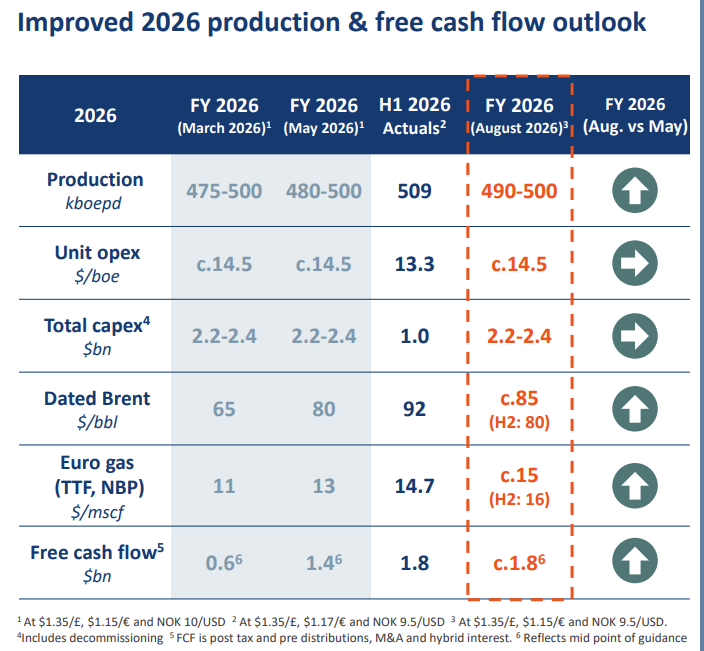
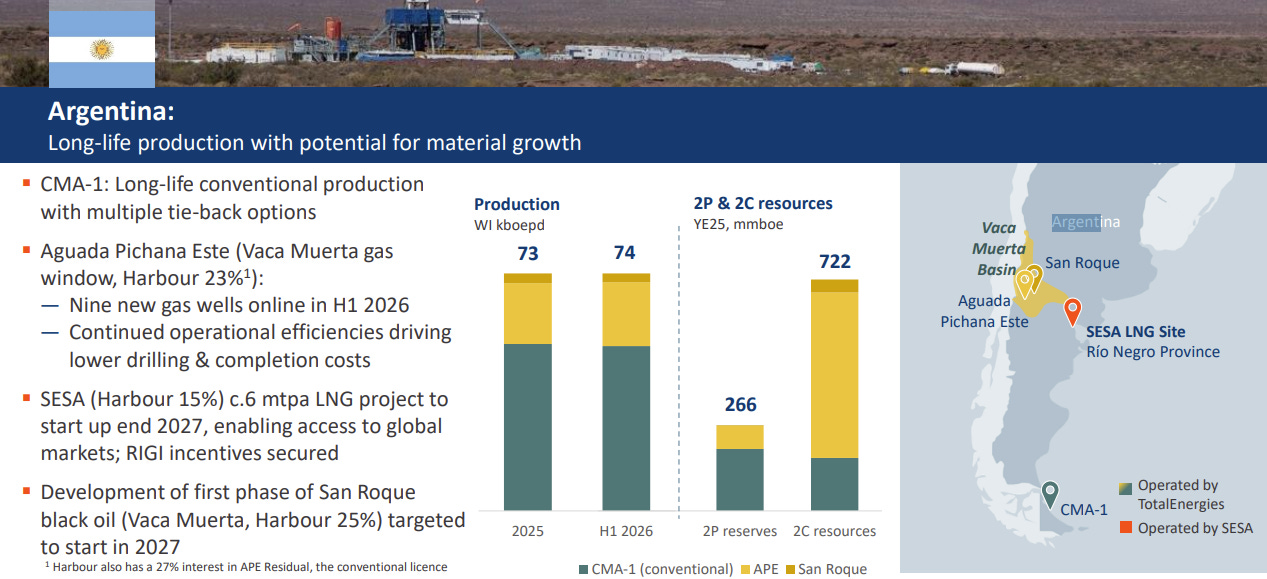
Where will that capex go? Into Vaca Muerta where Milei isn’t as silly as Milli (although presumably the two get to meet now that silly Milli is Foreign Secretary)
Only three years left until elections when we can get Milli banned. People of Doncaster I speak directly to you here.
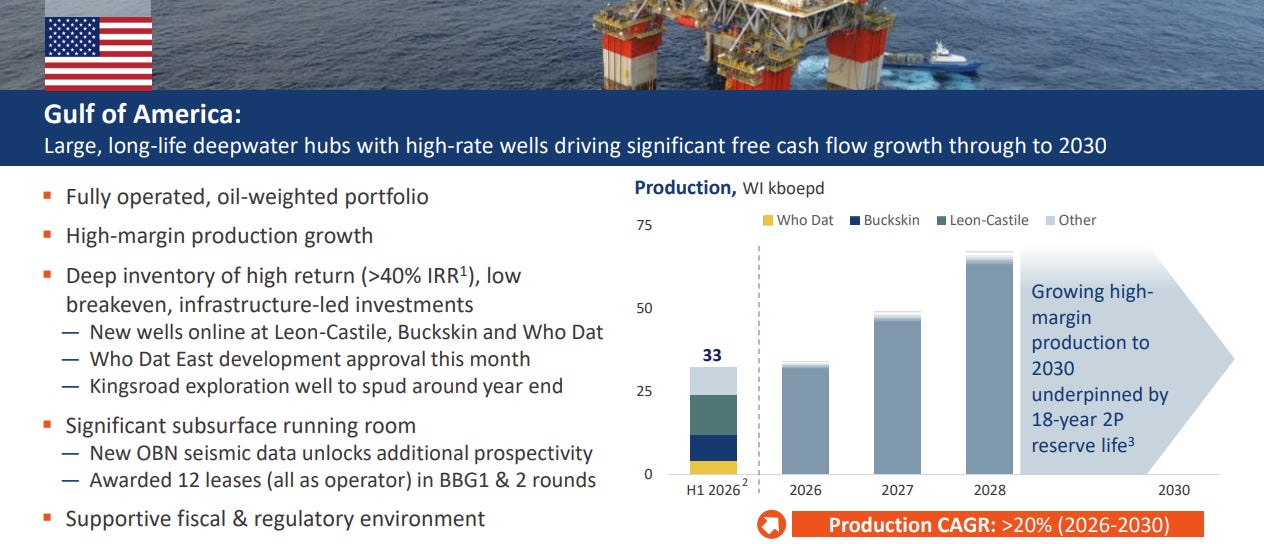
“Significant FCF growth” and “above 40% IRR” in the Gulf of America.
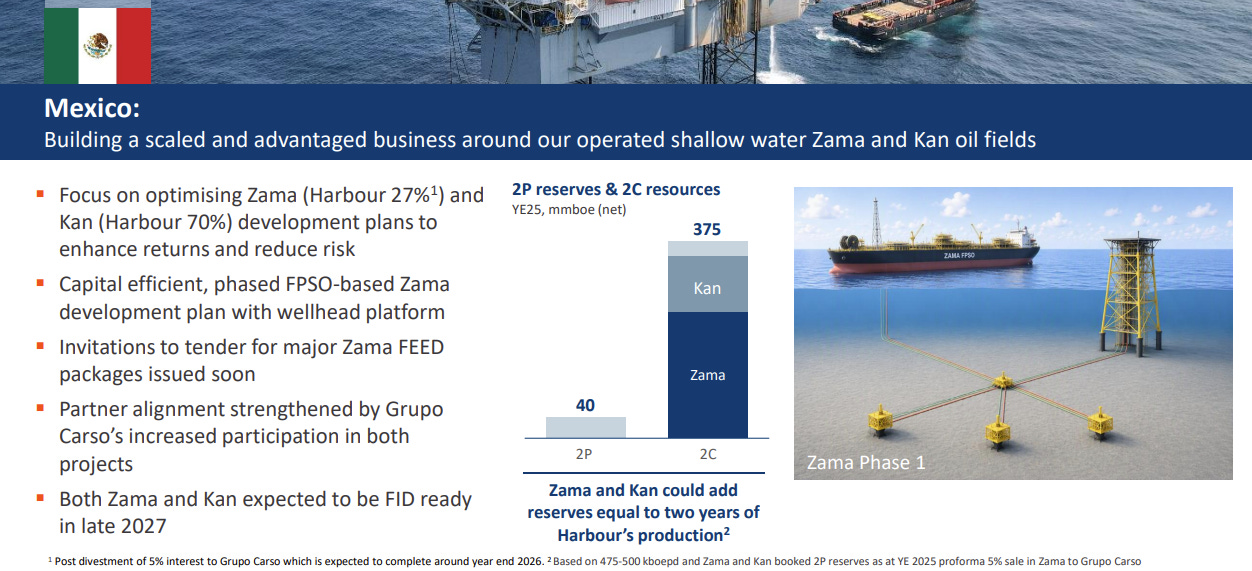
Earlier stage but Mexico too.
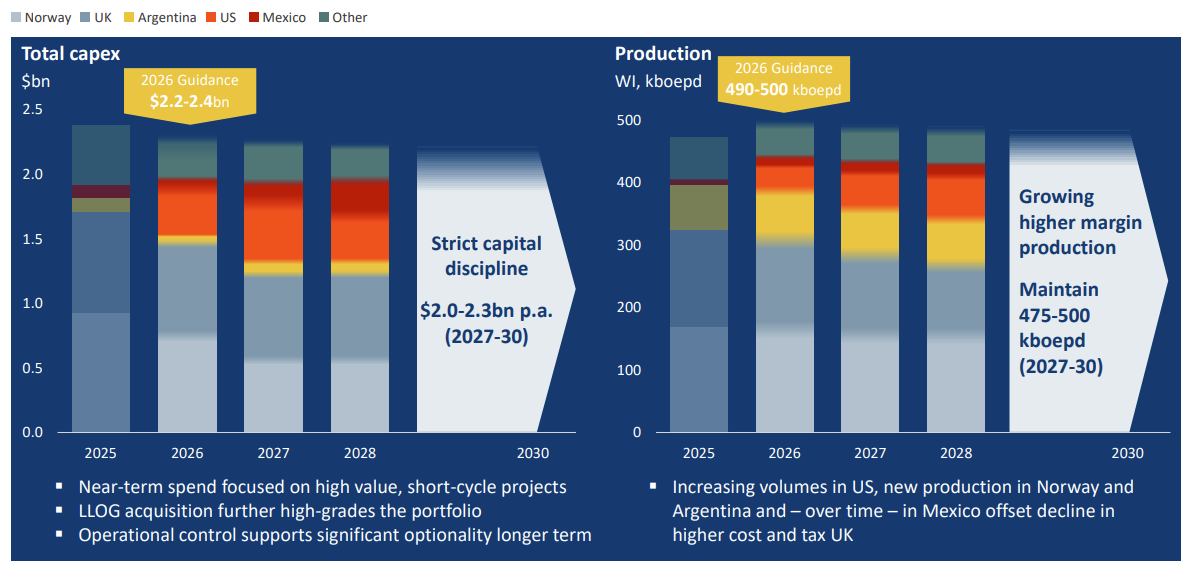
So broadly speaking keep production at 475-500 kboepd but the low-tax (non-UK/Norway) grows from 35% of production to about 50% during the next two years and continues to grow.
My own analysis estimates the blended statutory tax drops towards 54% in a 50/50 high/low tax world, with an effective tax rate (ETR) dropping from today’s ~81% to ~69%. Ceteris paribus that moves post-tax FCF from $1.8bn to $2.52bn and FCF Yield on a $5.1bn market cap from today’s (leading) 35% to an astonishing 49.4%.
Where is “more of the same” but at a lower tax rate actually in the price? This is a mix story, not a volume story
There is a tax lag effect at HBR. Statutory Profits in Year One are 50% Tax Collected in Year Two in Norway. A good 2026 therefore pushes cash tax into 2027. This is a major reason brokers show a soft 2027. But this is timing rather than deterioration.
78% is a permanent state of affairs in Norway but theoretically the UK windfall levy is due to expire in 2030 - and is a free option the market prices at zero. With an election being fought in 2029 I suspect Energy Security will be fairly high up the agenda and Aberdeen will be a topic of conversation particularly in Scotland. Labour are exposed due to the damage done to Aberdeen’s economy.
Broker Forecasts
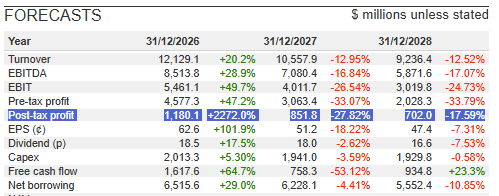
Brokers don’t share any enthusiasm for HBR. Their numbers show declining profits, from these lower-tax countries with 40% IRR, they forecast barely any reduction of debt and in fact a $1.3bn INCREASE of debt in 2H26 from 1H26, and a shrinking FCF in 2027 and 2028, despite HBR’s own guidance of a GROWING FCF.
Oh and a reduction of revenue from $6.4bn in 1H26 to just $5.7bn in 2H26. It’s now August.
Broker models typically factor in routine Q3/Q4 North Sea maintenance downtime, derivative hedge settlements, and forward-curve pricing, which could explain the variance. But their models didn’t accurately forecast the 1H26 outcome. Revenue was +20% to their aggregate forecasts, EBITDAX +15%, FCF was 300%, Opex was 10% lower than forecast.
Crucially HBR themselves affirm their own guidance that conflicts with their models.
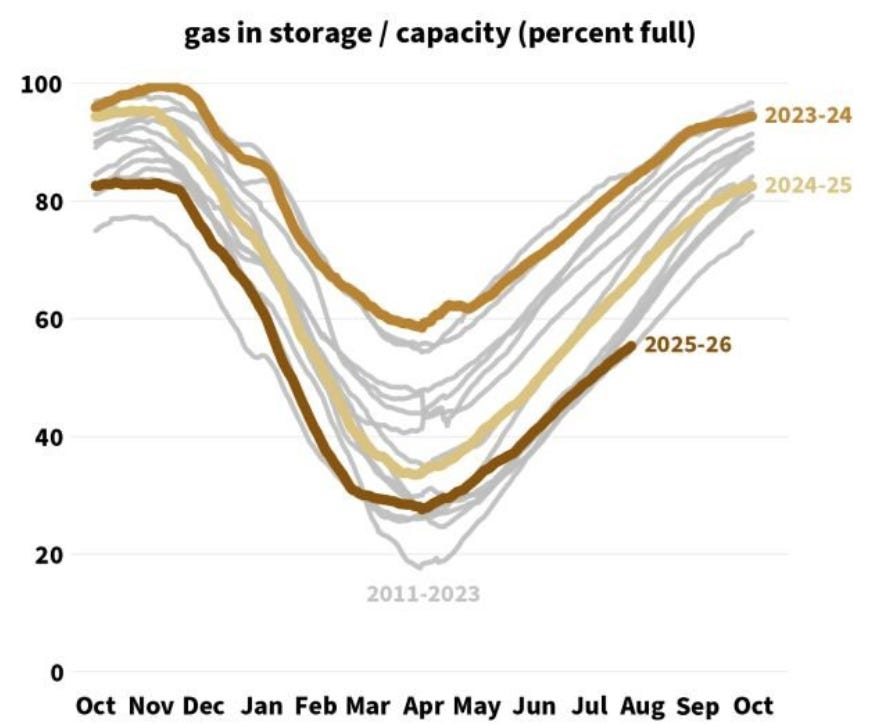
Hate to say it when it is yet another beautiful day outside but winter is coming. European gas storage as I write is barely above 50%.
How will HBR only achieve $5.7bn of revenue in 2H26 exactly when it is a major vendor of European gas? (i.e. can supply without the LNG cost penalty)
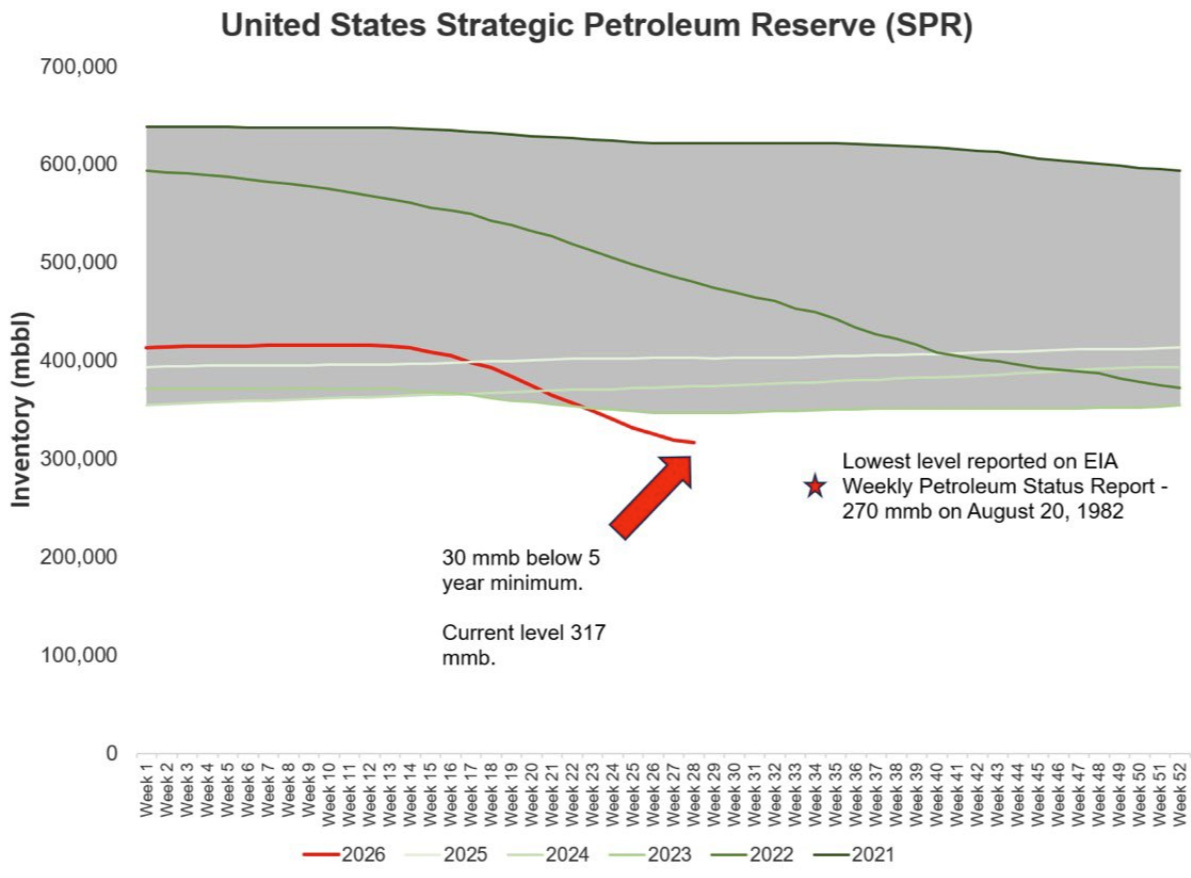
The SPR is getting closer to tank bottom and to legal minimums.
Do brokers guessing at HBR’s results need to guess again?
Vast reserves remain
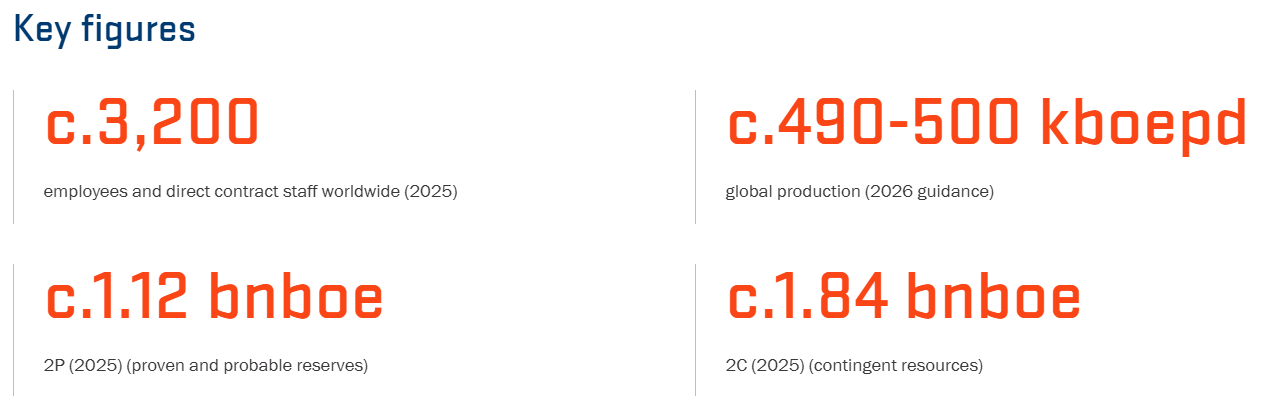
HBR tell us their 2P resources and 2C resources total 2.96bn barrels of oil equivalent for $5.1bn is paying $0.58 per barrel of Oil in the ground. Stuff you sell for $85.00 a BOE and costs -$14.5 per BOE to extract.
$85 is a 12,100% mark up from 58 cents. Before discounting for risk, and deducting for tax and other deductions of course.
Nevertheless the market cap is objectively cheap relative to its peers. Just considering Proven HBR is valued at around $9 per barrel of reserves vs ~$18 for Ithaca and ~$21 for Aker BP. It’s true that the 2P reserve life is ~7–8 years so is a genuine structural weakness. Extensions will require Capex.
Why is HBR going cheap?
Some readers have said ah but this will stay cheap due to ongoing selling.

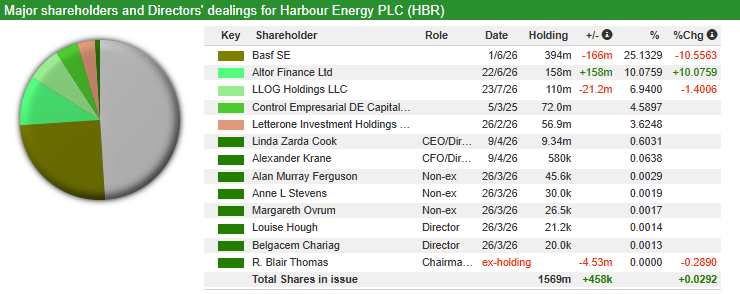
EIG (a founding backer) dumped its entire remaining holding at 205p on the 3rd July, accepting a discount to exit.
Temporary selling, and about halfway complete - where 2H26 buybacks can hoover up about half of the remaining half. Is the world following those broker guesses and concluding HBR offers poor prospects?
I guess HBR will be less appealing to short-term traders, due to the selling, but extremely interesting to OB readers who love deep value. Once it finishes, a major headwind disappears.
Conclusion
HBR has a track record of strategic, operational and financial delivery supported by active portfolio management and a world-class team. That’s another comment from their IR.
For me there’s a massive disconnect in forecasts, massive disconnect in the paper markets vs physical markets and I’m sure I could use the word massive to describe prospects and outlook too.
The cash machine aspect of HBR is the piece I come back to, and its asset development programme and the outlook for that too.
The reduction in tax take in the coming year is nowhere in the price. People see flat production I see increasingly profitable production simply due to the share of tax take.
Moreover the 78% tax element is painful but it’s also a piggy bank that offsets some of the liabilities on its balance sheet too.
Regards
The Oak Bloke
Disclaimers:
This content is for educational and informational purposes only. It does not consider your personal circumstances and is not financial, investment, tax, legal, or professional advice. Nothing here is a recommendation, offer, or solicitation to buy, sell, or hold any investment. Investing involves risk, including the loss of capital. You are solely responsible for your own decisions
Micro cap and Nano cap holdings including FTSE250 companies might have a higher risk and higher volatility than companies that are traditionally defined as “blue chip”
Unfortunately in the UK Decom expenditure cannot be offset against profits subject to EPL and so UK government only contributes 40% towards future UK ABEX, unlike Norway who effectively fund 78% of ABEX. Also the future Government contribution to ABEX sits as an asset in the balance sheet as a deferred tax asset.
Interesting read thanks - I’ve been picking up HBR for a while now as I like the stock. There is an article on HBR published today in Investors Chronicle that may be of interest too, assuming will be in tomorrows magazine.
https://www.investorschronicle.co.uk/content/5d26ca2c-5f8d-47b9-bd31-e2317e00d328