
Farewell Wilson!
An expert take out by the SAS (shipping)


Dear reader,
After saying Farewill yesterday today it’s Farewell too!
Well done to those who followed my idea back in February in “Farewell Wilson?”
Today’s update removes the question mark.
However BIZARRELY I’ve been able to top up at £15.20 just now.
How? Is it overlooked maybe?
While the sale price of R$17.5 is below the speculated R$20 valuation the deal nevertheless repesents £16.95 per OCN share plus there is £6.71 of mainly listed holdings in OCN also.
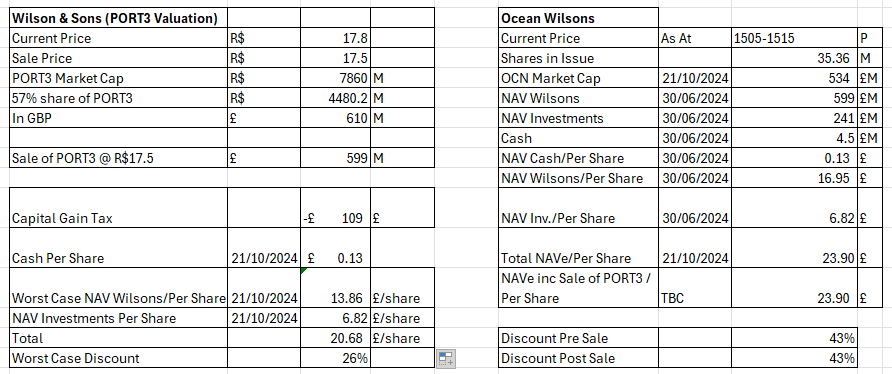
The deal doesn’t complete until H2 next year, and Wilson will pay OCN dividends until then at a 5.2% yield which is a further 68p per OCN share based on 3 dividends.
What might have also soured people to this is there is a consideration of Brazilian capital gains tax (which could be up to £105m in a worst case scenario or £3.09).
But do the maths. Or see my maths above. If you look at the bottom left of the above chart the worst case scenario is a net £13.86 per share of proceeds and with the Investments and Cash still arrives to a 26% discount.
26% discount where (including the dividend) £14.67 of £15.20 is backed by cash and will be distributed via share buy back, special dividend with some possible further investment too.
So you are really only paying 53p net of cash for £6.82 of listed funds - even under the “Worst Case” scenario for Funds covering global equities, Hedge Funds, Private Equity and Bonds.
So you are really only paying 53p net of cash for £6.82 of listed funds covering global equities, Hedge Funds, Private Equity and Bonds. Arguably, it gives you access to a range of funds that a Private Investor wouldn’t directly access - only accessible to High Net Worths. So if you want exposure to an unconventional global array of funds then OCN offers that too.
In 1H24 these delivered a 3.3% net return and average 4.8% return over 5 years.
But I don’t need to tell you - do I reader - that £6.82 at 4.8% is 34p
So 34p for a net 53p investment is a 64% annual yield (assuming the past 5 years is representative of the future which it might not be of course)
But what a margin of safety!!!!

These are the Top 30 disclosed:


If we break down the data we see (of the Top 30 holdings) 77% are listed, 20% unlisted and 2% bonds.

In the broader portfolio (as of 31/12/23) $80m of the remaining $100m is Private Equity, $6m Bonds and the remainder Hedge Funds.

Is the Fund Portfolio Stodgy?
I would question the assumption made that the fund portfolio is doomed or stodgy. The top two publicly-listed funds show strong performance over time.


Private Equity
The largest private holding for example is Nexus Group - Peru who are focused on investment opportunities provided by the dynamic Peruvian macroeconomic landscape and the country’s emerging middle-class population. Economic growth over the past 10 years averaging about 3.5%.
NG makes control equity investments, focusing on creating significant value through strategic operational and financial improvements. NG appoints senior investment professionals to management positions in its portfolio companies:
Grupo SMI (packaging company), Innova Schools (K-12 schools), NG Education, Financiera Oh!, La Tinka and Inretail Peru.
Considering Performance 31/12/22 to 30/06/24 (NB I’ve used latest available numbers where a holding didn’t exist 31/12/22 which was true in 6 out of 30 of the top 30)
Given the post covid period, rapidly rising interest rates, the supply chain crisis, the inflation crisis it possibly shouldn’t come as a great surprise to learn that Latin America hasn’t done well. But Latin America is a fast-growing territory in 2024.
Nor has Venture Capital. Yet VC trusts with Molten have nearly double bagged in 2024 and HGT is a nearly 0% discount to NAV. Or consider HVPE - a fund of funds like OCN - announcing NAV growth and 29% premiums to carry this week.

So there’s potentially circa $10m tied up in overstated discount rates. Comparing with VC in Public markets and particularly the very rapid rise in interest rates (and discount rates) a de-rating of privately listed Venture Capital is no surprise is it? But as has been seen in the public markets the valuations are sharply discounted while the business performance of many PE/VC have actually been quite robust as I’ve proven time and time again in various articles such as GROW, CHRY, TMT and others.
The -$7.3m net loss in private holdings hides value I suspect. With interest rates falling leading to discount rates falling will we see a rebound in its VC/PE holdings?
Venture Capital is now in its 10th Quarter of downturn (2.5 years) - that’s now equal to the length of the downturn post 2008 and 1999. Will VC bounce in 2025? Statistically it is due.

Within VC there are already bright spots. Perhaps unsurprisingly we’ve seen a doubling of AI-related Venture Capital in 2024.


Meanwhile a $31m return on public holdings is actually pretty good. $31m gain on circa $200m of public holdings over 18 months is a 20% per annum return reader!
$31m on circa $200m of public holdings is a 20% per annum return reader.
Is that stodgy?!
Considering the Cash Proceeds
It’s true that there’s £48m of future commitments to funds but only £10m over the next 5 years.

Meanwhile there’s a 10%-20% disposal of funds with an average 20%-30% gain on disposal based on the past 18 months. Will shareholders express a desire for higher levels of reinvestment (perhaps yes if they’ve read this Oak Bloke article) or will they actually clamour for buy backs? (Or a higher dividend?)

The RNS speaks to two key next steps:
1/ Consultation with shareholders
2/ A mix of special dividend, buy backs and reinvestment.
There are some existing follow on investment commitments of ~£50m, so it could be there is some money set aside for that. But £40m of the £50m is >5 years distant so the number could easily be less.
While the current discount to NAV is 36% it has historically been far higher. It was 47% in February 2024 and 63% in September 2023 (on a look through basis). For that reason it's difficult to think the shareholder consultations will lead to 2/3rd of the proceeds being reinvested. Who will ask for this?
It's also the case that Wilson Sons whilst publicly listed in Brazil wasn't a tradeable asset in the same way that all of its other funds/assets are tradeable. Liquid assets usually trade on a 10%-15% discount, and ongoing buy backs can trim any outsize discount.
So assuming buy backs and/or a tender offer is the preferred route, as I believe is likely and assuming let’s say a £5.20 dividend, £0.30 reinvestment (i.e. £10m follow on investment), that leaves £8.50 for a tender offer.
Assuming a tender at a 5% discount to NAV a £300m tender results in an elevated NAV of £17.60 so a £22.80 per share return. Less any discount to NAV of course. So a target of £20.00 seems reasonable.
But forgetting OCN 5%-6% dividend yield is a further return, plus scope for future capital returns too.
A final intriguing thought: Will we see a counter offer for Wilson Sons? SAS weren’t the only interested party and R$17.50 is a very small premium to the market price, for an attractive asset with growing profits and opportunity located close not only to Southern Brazil but also is the primary port for Uruguay and Argentina too, I covered this in some detail in my article “The Complicated Story”.

OCN - update 14/11/24
Interesting to see in the Q3 update that OCN speak to per share £12.53 Wilsons + £0.49 cash + £6.93 per share = £19.95 NAV
Yet you can buy OCN for £12.60 this morning so if you are happy to consider Wilsons as pending cash then you are paying £12.60 for £13.02 of cash plus £6.93 of public/private shares.

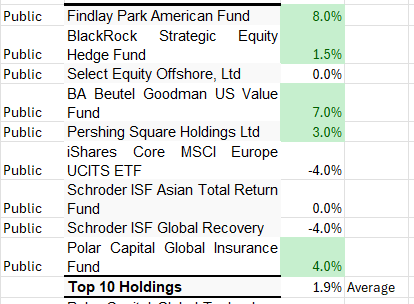
£6.93 as at the 30th September. Interesting to see - based on the top 10 publicly-listed holdings that these are up 1.9% since 30th September. If that is representative (it might not be) that’s 14p of gains.

The OCN investments have delivered 33.8% over 5 years, but interestingly new private equity is the strongest performer (106.7% return) and thematic the 2nd highest component. It’s designed as a 60:40 fund.
Interestingly it outperformed (by about 1% a year) a 60:40 composite of 60% ACWI+FM which is basically an Equity world index (as below) plus 40% of Bloomberg Global Treasury (Bonds)

Also of interest is the 24% NA quality and growth, but where this is being focused across towards Japan but also towards Bonds and thematic funds particularly Insurance where Reinsurance is a growing category.

By working towards greater balance and diversification OCN offers a balanced portfolio.

Regards
The Oak Bloke
Disclaimers:
This is not advice
Micro cap and Nano cap holdings might have a higher risk and higher volatility than companies that are traditionally defined as "blue chip".
Trying to decide whether Hansa is the play here. The double discount looks crazy and the two ITs have such similar fund investments that surely a merger or some kind of restructure is forthcoming.
This is what Jefferies analyst had to say, for what it's worth...
"Jefferies has made a change to its rating for Ocean Wilsons Holdings Ltd (LON: OCN), downgrading the stock from Buy to Hold and adjusting the price target to £17.25 from the previous £19.00.
The firm's analyst cited a significant narrowing in the company's Net Asset Value (NAV) discount, which has decreased by 31 percentage points to 24% over the last twelve months (LTM), closer to the historical average of 34%. This shift followed the announcement of a strategic review in June 2023.
Ocean Wilsons' NAV discount narrowing is partly attributed to its ownership of Wilson Sons, which accounts for 63% of the company's NAV, with the remainder being cash and liquid investments.
The reassessment of the stock's rating reflects the agreed price for the PORT3 stake, which has prompted the new price target of 1,725 pence. This target represents a 15% discount to NAV, aligning with the average discount observed among UK investment companies."